
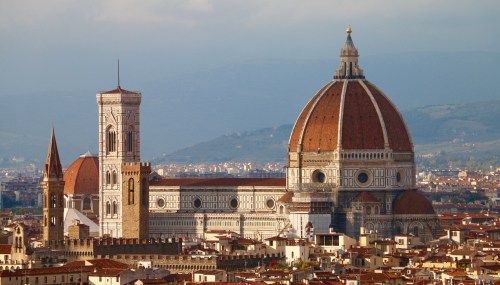
Yesterday, October 19, Don, Myra and I walked into town and bought tickets to climb up the dome of the Duomo. Surprisingly, there were very few people in line, so we got in quickly. It’s a long way up in a narrow stone stairwell on spiral stairs that are too close together for big American feet. I joked on the way up that my claustrophobia was fighting it out with my acrophobia and I didn’t know which would win. In truth, it would be the claustrophobia as I’m not really afraid of heights.
There are only a couple of places on the route up that don’t involve steps. One is a sort of catwalk around the bottom of the cupola far above the floor of the cathedral. When you look down it’s so far that you’re convinced that you must be near the top; then you look up and realize that you’re about halfway.
When you leave the catwalk you enter an even narrow and steeper set of stairs. It was about halfway up this flight that I broke a sweat and felt that my legs were feelin’ the burn. But there was no choice but to continue.
And then there was a narrow opening above us and we climbed out on the narrow terrace that encircles the dome. After the heat of the climb it was a relief to be in the wind and feel it drying the perspiration. I worked my way around the perimeter taking photos from every vantage point, until I came again to the hatchway down.
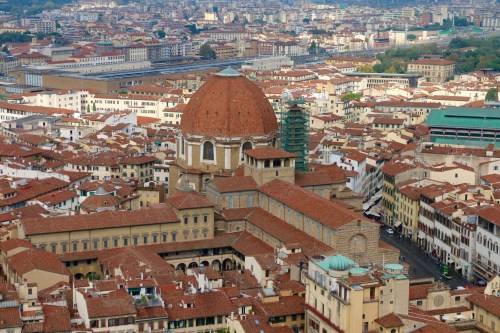
The Medici Chapel from the top of the Duomo climb.
*****************************************************************

The Great Synagogue of Florence.
******************************************************************
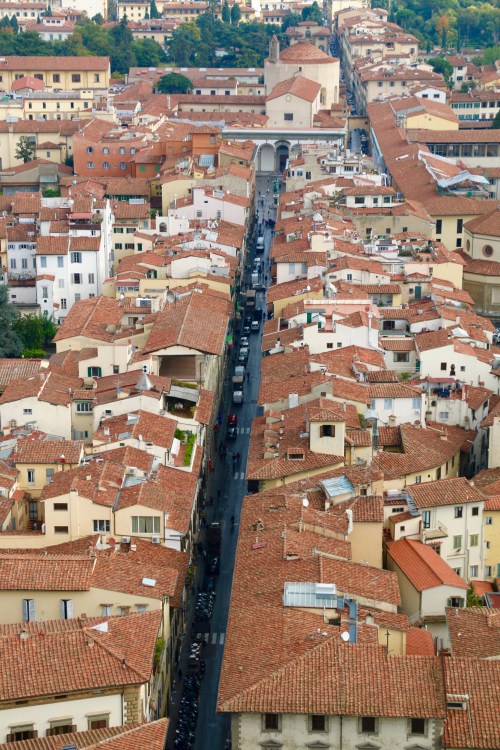 Looking down on a street scene in the heart of Florence.
******************************************************************
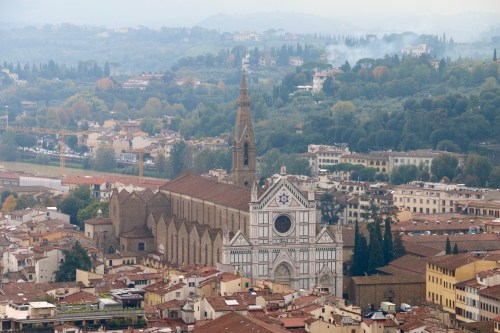
An aerial view of the Basilica Santa Croce, the church that houses the remains of many famous Italians.
***************************************************************
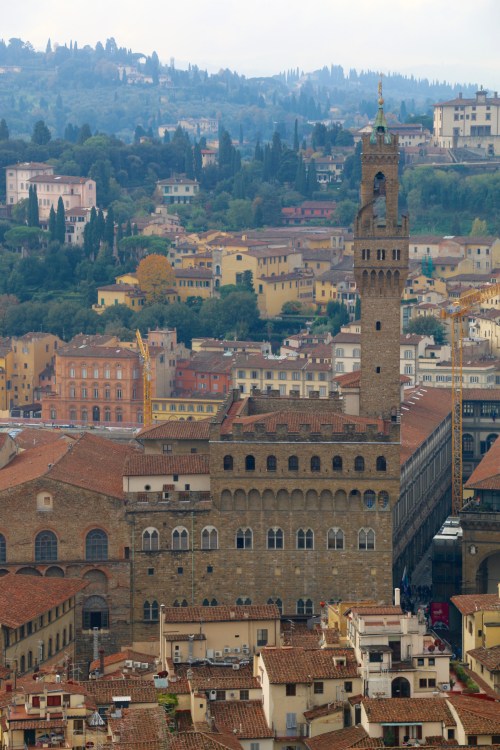
The Torre Vecchio, the Old Tower, and the Palazzo Vecchio, the Old Palace, there the Signoria, the ruling elite of Florence, met.
****************************************************************
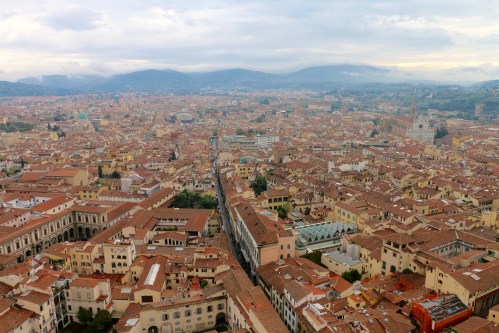
Another scene looking roughly east from the Duomo. Santa Croce is on the top right. You can almost see our house from here!
*****************************************************************
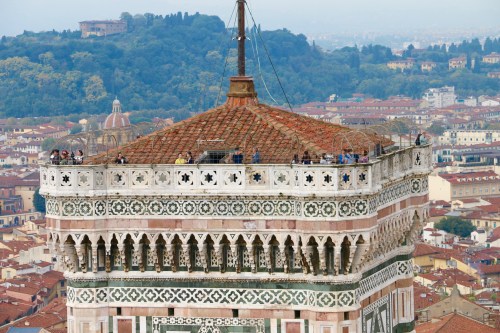
Looking across the roof of the dome toward the Campanile, the Bell Tower, which was designed by Giotto. It’s adjacent to the Duomo but is free-standing. From the ground it appears to be just as tall as the Duomo, but from this vantage point it’s clear that the Duomo is higher. In fact, by law no building in Florence can be taller than the Duomo. None of the color in the Campanile is paint– it’s all different-colored marble.
*****************************************************************

Looking down on the Piazza della Republic, one of the larger piazze in Florence.
*******************************************************************
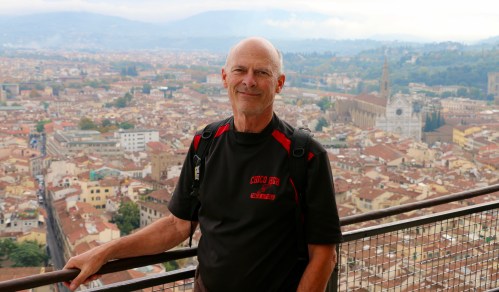
Some random tourist photobombing the shot.
**************************************************************
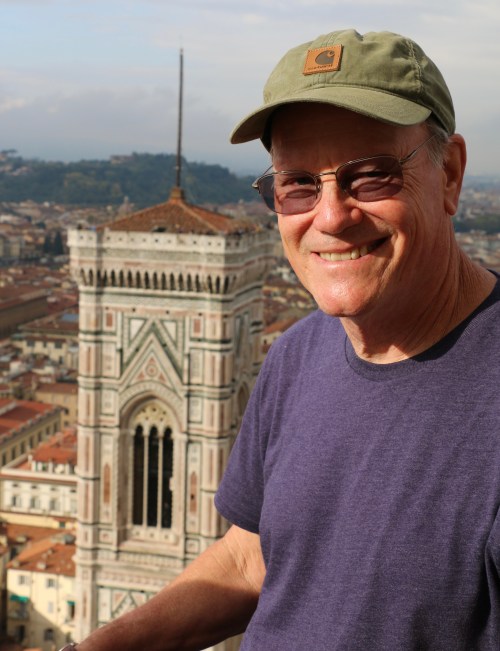
Don Bailey on top of the world.
****************************************************************
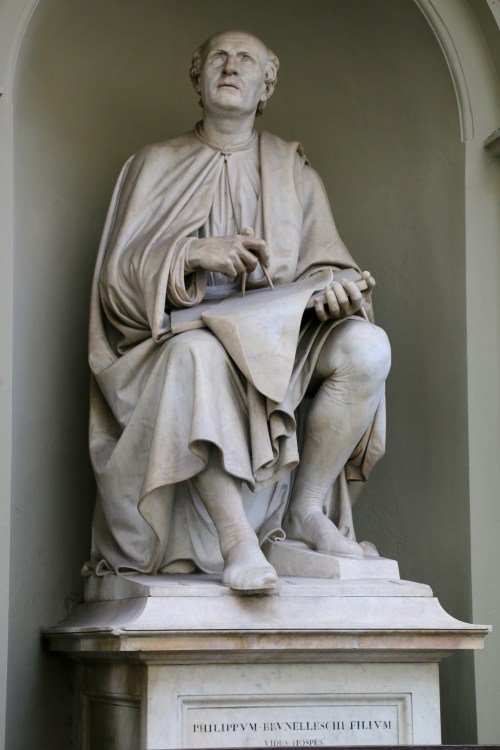
And we’ll end this section of photos with Brunelleschi, who was the genius who figured out how to close the dome. The roof had been unfinished for years. The church had been begun in 1296 and it stood without a roof until he solved the puzzle of a roof 150 feet across that started 180 feet up. They didn’t want the supports typical of northern churches– flying buttresses and the like– so they looked for a different approach. They announced a contest for the design of the dome and the best artists and builders of the age submitted plans. Brunelleschi proposed a dome-within-a-dome. He refused to tell anyone how he planned to accomplish this but somehow won the contract and succeeded where nobody before him could have. It was such a huge project that he had to invent some of the equipment– cranes and hoists, etc.– to lift materials that high. It was finally finished in 1436. This statue stands beside the dome, depicting the builder staring up at his solution (which was “borrowed” later by Michelangelo in order to close the dome of Saint Peter’s in Rome).
***************************************************************
We stayed up on top for most of an hour, and then started down. It was then that I began to suspect that, like many Italian systems, this one needed a bit of tweaking. First we had to wait while a long line of climbers exited the passageway before we could start down. I referred to it as “la linea interminabile,” which I didn’t even realize at the time was actually correct Italian for “the interminable line.” Finally we were given permission to start down and for a way our route was unobstructed. Then we met the next group of people coming up. We tried waiting for all of them to pass, but that was futile as the line was, well, interminable. A time came when I stopped being polite and just squeezed past them as they were bottlenecked in place, waiting for those above them to move up. At first I apologized: “Scusi, scusi,” but soon gave up even the pretense of politeness and just jammed past them. Understand, we’re talking about two adult human bodies simultaneously occupying the space one alone would ordinarily feel uncomfortable in if limited to such a small area. But I had the advantage of gravity pulling me down, and I guess I was also making room for Don and Myra because they were right behind me.
And then we were down and out and looking back up and saying, “We were just up there!”
I had climbed the Campanile before, Giotto’s bell tower adjacent to the Duomo, but this was the first time I had climbed to the top of the dome. Probably the last. Someone at the bottom needs to be counting people going up and people coming down and limiting the number going up to the number exiting at the bottom to avoid the traffic jam we experienced. I’m going to write a letter to the editor and they’ll probably just jump right on making that correction…
And then we rewarded ourselves with lunch at Trattoria Gusto Leo before the walk back to the apartment.
*************************************************************
Typically, the days start with coffee in our kitchen and then when we’re properly caffeinated we move off in our various directions in various combinations of people to walk and look. It’s a pattern I heartily recommend.
I’m getting more exercise on this trip than I have in years, averaging (as I wrote in my most recent post-let) just over five miles a day walking. As a weight-loss program it’s more expensive than P90X. But the thing about walking here is that you don’t seem to notice how the mileage piles up until you get home foot-weary and sit for a while. Last night after dinner, after a day of walking around downtown, we went back out and walked another mile + in search of gelato, not the easiest task to accomplish on a Sunday evening in Catholic-Land, but we found a gelateria in our own neighborhood and the additional walk helped assuage any guilt about the extra calories. I can’t really tell if there’s weight-loss happening (I could certainly use some) but I’m on a notch in my belt that I haven’t used before. I take that as a good sign.
As noted elsewhere (FB) my friend and former colleague and now-fellow-retiree Bob Kohen was in Florence with his enamorata Pamela. We met at his hotel, which was just up the Lungarno from our own apartment (a mere mile!) and took a quick walking trip around the center of old Florence. As a history major and teacher, Bob was particularly attuned to the stories of this amazing city. He noted something of which I am also aware, which is that these important elements of what we might once have called “Western Civilization” in our Pre-PC days are for the most part virtually unknown in American education– with possible and occasional exceptions such as the French Revolution– and that only because of our own. We learn nothing of the historical import of what happened in just this city, Florence, alone, not to mention what was happening concurrently in Venice and Rome– or for that matter in Berlin and Moscow and Paris and Madrid and London… And yet the flow of events here directly impacted our own development as a nation.
Too often History is taught as a series of names and dates instead of as related stories of events. Of course names and dates are important, but I think it’s more important for people to understand how one event impacted or influenced or even created another, how lives impacted lives. When I was learning history in high school it was the most boring subject I had, and that’s including math! It wasn’t until I took a California History class in college that I had a teacher who was able to show up how what happened then directly impacted the development of our own state, our own western movement, and what was once called, with a mostly-straight face, Manifest Destiny.
It’s almost amusing that we are first taught Toddler History in elementary school; then we’re re-taught the same topics in junior high and told that we hadn’t had the “full story” in elementary school; then we hear the same thing in high school when we delve a tiny bit more deeply into the subject; then if we’re lucky enough we might get a glimpse behind the curtain in a college history class. And all along we hear, “that’s not the real story. Here’s what really happened…”
Of course, there’s also another element that we don’t like to take out and look at, and that’s the old saying that “history is written by the victors.” When we read history, we like to think that we’re reading about facts that we can believe in, but frequently we’re just getting someone’s opinion about what happened, often someone with his own agenda, conscious or unconscious, his own biases and prejudices. Historians pick and choose their factoids just like everyone else. What can we do about that? Keep an open mind, I suppose. Everyone has a story worth hearing, even the vanquished. Maybe especially the vanquished…
That evening Bob and Pamela and I had dinner at a restaurant I like called Il Cantastorie. It’s one of my go-to places here in Florence. We ate a great meal, told lots of stories, drank some very good wine and had a wonderful time together. It’s fun to get to know people you think you already know. Context is so much of our relationships with others.
One of the things I noticed fairly quickly about teaching– because I was a little older than other new teachers and so the colleagues I gravitated toward were my age or older– was that the friendships we have in the job often don’t last when the job is over. I saw people retire and then disappear from the social network. It made me feel that many of the so-called friendships were simply based on seeing one another conveniently every day at work, and when that convenience was gone, when seeing one another required any degree of effort, however minimal, the friendships dissolved like water in water. It’s after retirement, or even merely changing job sites, that we learn who our genuine friends are, and the number is, sadly, a small one.
That’s why it was so gratifying to spend some time with Bob Kohen. We hadn’t been “pals” at CHS, but we were friendly acquaintances and often found ourselves talking at school functions. We team-taught one year. But we never really socialized without the structure of the educational environment. Talking during our walk, and then the deeper conversations during dinner, helped cement a different kind of relationship, one based not on working together but on simple choice. We had fun. We laughed. I hope to do it some more.
The next day Don, Myra and I were going to Rome to meet Julie Battinich Passalacqua, but we learned to our disappointment that there was a national rail and bus strike so those plans were dashed. I had suggested a restaurant in Rome for dinner, a place Tom Welgan and Kathy Lundquist and I had found accidentally when we were here last. Julie made reservations and I heard from her that they had gone and enjoyed it. It’s called “I Buon Amici,” The Good Friends. It’s a place Tom, Kathy and I happened upon one Sunday night when we were staying at Hotel Luzzatti. We had wandered aimlessly around the neighborhood looking in vain for a meal when far down what looked like an alley we saw a neon sign in the darkness and so found the restaurant. We were the only tourists in a room full of Romans so they put us in an adjoining room, where we were soon joined by other hungry tourists. I had noticed pictures of Giancarlo Giannini on the wall as we entered the room and stopped to comment on them to the person escorting us to our table (who turned out to be one of the owners), telling him that Giannini is one of my favorite actors, and mentioning some of his greatest films, “Seven Beauties” and “Swept Away” (not that p.o.s Madonna made, but the original Lena Wertmuller film) and suddenly his attitude toward us changed and we ended up having a great meal and a great time, and I’ve recommended the place to anyone who will listen and several who didn’t.
We missed seeing Julie, but we’ll get together in Sacramento when we’re all home and go out for some Italian food. Same thing, right? Maybe someplace swanky like Olive Garden.
***************************************************************
More to come… Meanwhile, here are some pictures that probably won’t otherwise find their way to publication on this pile of words.


These are details of the Duomo and the Campanile. Remember that all the color is from the marble itself.
**************************************************************


This is the Baptistery, which is just a little across the Piazza from the Campanile. By law, every citizen born in Florence was required to have his birth recorded here within three days. The doors were designed by Ghiberti, who won a competition for the job. When he saw the work, Michelangelo called them “The Doors of Heaven.” They’re often referred to as “The Gates of Paradise.” These hanging outdoors exposed to the elements are copies of the originals, which are in a nearby museum.
 soggiorno13
My favorite lines:
When I was learning history in high school it was the most boring subject I had, and that’s including math!
It’s fun to get to know people you think you already know. Context is so much of our relationships with others.
Enjoying the entries, Robert!