
Continuing the catch-up phase, I’ll be moving through some of the past days at a rapid clip. This is the October 12-14 phase of the voyage…
As mentioned in the previous post, Don and Myra took the fast train to Barcelona, while Richard, April and I flew to Jerez de la Frontera. Although it serves the entire region, including both Sevilla and Cadiz, Jerez airport is fairly small– especially after being in Heathrow, Gatwick and Madrid– but it was well-organized and we were in and out pretty quickly.
We had reserved a rental car, an Opel that isn’t sold in the USA (?!?) and set off for our hostal in El Puerto de Santa Maria, a small coastal city about midway between Rota and Cadiz. The surrounding countryside of this area of Andalusia had been locked in a serious drought for months, and the recent rains were welcomed. Geographically, the region looks a lot like northern Baja California, with relatively flat land broken up at irregular intervals by cotton and milo fields, interspersed with prickly pear cactus and some species of agave. Even the architecture looked like Mexico– or probably it’s the other way around– no doubt a reflection of the climate: whitewashed walls and terra cotta-tiled roofs. The air felt humid, which might lead you to think that it would be lush and green, but it’s more like a desert.
And thus began a series of frustrations, most of which became fodder for eventual amusement.
The first issue was with Google Maps, or more accurately, the computer-generated voice that we came to refer to as “her.” The problems broke down into a couple of general categories, one of which was fairly innocuous. That was the way “she” pronounced Spanish place names. “Avenida de Terrorismo” became something like “Avenidda de Te Ro Riss Mo,” with each syllable pronounced as though it were a complete word, and no attempt to replicate Spanish pronunciation or rhythms. One we heard regularly made me laugh every time because it seemed somehow appropriate in our circumstances: Whenever she said, “Calle de Las Casas” it sounded almost exactly like “Call-e de Lost Causes,” which was sometimes far too close to the situation we were then dealing with.
The larger issue with the GPS “woman” was that “she” (ok, I’m dispensing with the quotation marks and will henceforth refer to the voice as though it were a human)kept telling us to do things that were physically impossible, at least in this particular dimension. We would be told to “get in the left lane and prepare to exit the highway,” and then when we reached the spot (and she became more insistent) the exit would actually be on the right as one might reasonably expect a freeway exit to be, and we’d miss the turn and have to go to the next exit, that might be 5 miles farther down the road. And all the way to the next exit she’d be constantly nagging at us to “make a u-turn in 400 meters,” which would have been complicated by the concrete barrier between the two directions of travel. The combination of her annoying voice and bad directions occasionally led us to miss multiple turns before we began to apply common sense and more or less ignore what she was saying– not always without shouting at her to “shut the hell up!”
I came away with the conviction that it would be a nice idea for Google’s representatives to actually drive the highways in question to learn that freeway offramp are most often on the right in countries that drive on the right, and it would probably also be helpful if they would realize that it’s best not to collide with concrete walls when making u-turns. I wonder if they could also update their software so that the voice could at least approximate a reasonable-sounding effort at pronouncing Spanish words. I’ll bet if I email Google they’ll jump right on it.
Eventually we found our hostal in spite of the directions and I was pleasantly surprised. I had expected that we’d be in dorms or cells of some sort, but instead Hostal Alhaja was a clean, quiet and charming little place more like a hotel than a hostel. Maybe a hostal is something different from a hostel. We met Luis, the owner, and he took us to our separate rooms, each with its own bathroom, and because the rooms were on the second floor we each had a view. Given, the view doesn’t extend for any great distance because of the flatness of the land, but we were able to look out over the rooftops of the neighborhood. The view out the back was much better. The rooms came with a continental breakfast made up mostly of cellophane-wrapped breads and croissants or rolls, but the coffee was good and they also served orange juice, so we began both days with a caffeine rush, the way days are supposed to begin.
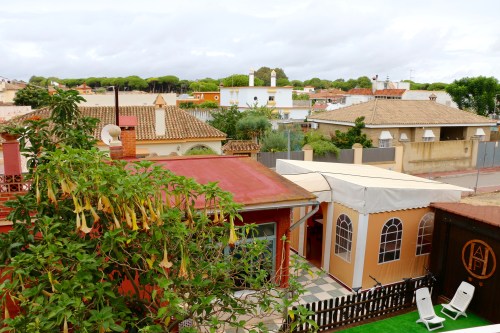
View from our terrace of the Hostal Alhaja.
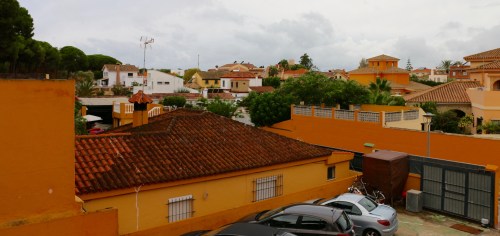 Parking lot and neighborhood.
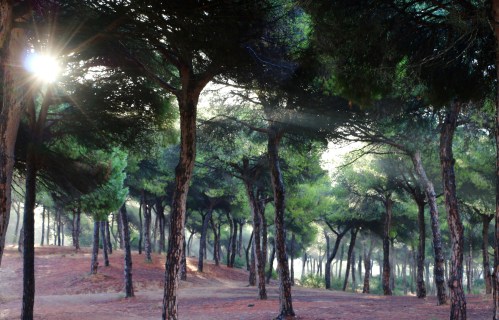
The view out my back window.
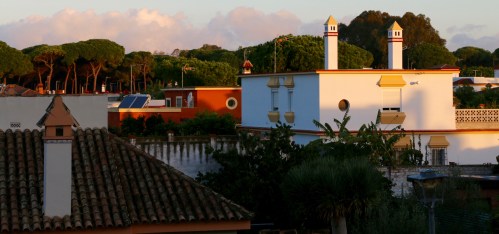
The view out the front over the roof of the hostal.
That night we drove into the main part of the port and walked around the town, which is laid out in a grid pattern of low, white buildings with narrow streets lined with shops and bars and restaurants. It’s a relatively small city of about 88,000, but most of the residents live in the suburbs so the downtown feels much smaller. I liked it very much. It appeared to be a prosperous coastal fishing village and most of the outdoor restaurants were full of people eating and drinking and talking. I thought it looked vaguely familiar and then remembered an episode of “House Hunters International,” when an American who worked on the US military base in Rota was looking for an apartment in the town. We strolled around and finally settled on a restaurant and ate. The food was good. I had fish that tasted fresh-caught. It was typically inexpensive and we lingered at the table for a while after finishing. Then we walked into the town again and found a heladeria, an ice-cream shop, and tasted their wares. Muy delicioso! Then back to the hostal for some quiet time. The WiFi was free but spotty and slow, so I didn’t “Netflix and chill.” Instead I read. I brought four books and am only on number two.
In the morning we charged our batteries with espresso and set off for the naval base at Rota, where Richard was stationed in the early to mid-60’s. This visit had been the initial motivation for us to go to Spain, and had been the prime focus of this particular portion of the trip. Frustration. We found the base, even though things had changed a bit in the intervening years, but we couldn’t get on the base. Richard and April could, but not with me. The US Navy was cool with me coming in, but the Spanish soldier stationed outside wouldn’t allow it. Why they cared when the Navy didn’t was beyond me. I offered to stay outside while they looked around, but instead Richard swallowed his disappointment and we soldiered– er, sailored on.
Off to Gibraltar. It was a long drive on good roads. I had no idea of what to expect other than the impressions gathered by photos of a quaint English village-type scene with clean sidewalks and streets lined with shops and restaurants, all peopled by sun-tanned residents with stiff upper lips and British accent. Maybe we’d hear a “cheers!” once in awhile.
Bitter disappointment on all fronts. I cannot in good conscience recommend that anyone go to Gibraltar for any reason, unless it’s simply to check it off a lifetime bucket list. It’s crowded, dirty from seemingly constant construction, absolutely charmless and depressing. It’s difficult to get in past the double phalanx of Spanish customs and then British customs, and then it’s just as hard to leave. In between is a mess, like a poorly-maintained theme park characterized by exorbitant prices and lackluster service and choked with tourists all sharing the fog of disappointment.
The place itself, absent the human environment, is admittedly beautiful– a deep water port, the straits of Gibraltar, the view of Africa, the Rock itself… But I was left feeling distinctly underwhelmed. The Rock, for example, is limestone, not the granite I expected. As a former climber I wouldn’t want to trust it. It rises about 1,400 feet, which is pretty impressive until you consider that El Capitan in Yosemite rises about 3,000 feet. You could put Gibraltar’s rock in Yosemite and nobody would notice it. It is only its location that marks it as notable. We heard that the British residents of Gibraltar pay no taxes and are provided free housing, probably a political “bribe” by the British government to maintain a steady population in the disputed area, which Spain wants back and Britain refuses to relinquish due to its strategic location. Every worker we saw or spoke to in Gibraltar was either Spanish or African. I don’t know what the Gibraltar-ese do.
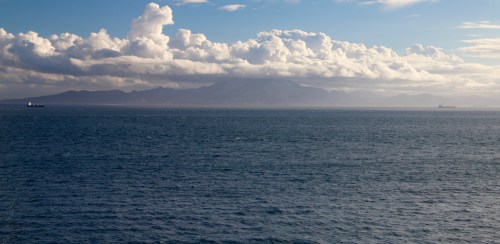
Africa across the Strait of Gibraltar
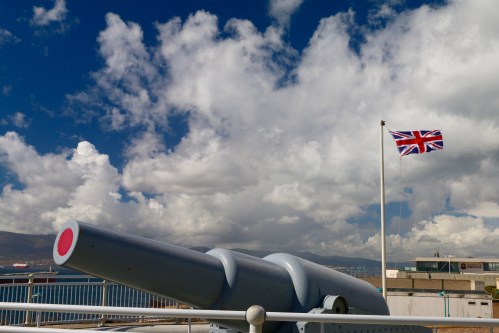
WWII vintage canon to control passage through the Strait.

Mosque at Point Europa, the southernmost tip of the Iberian Peninsula.
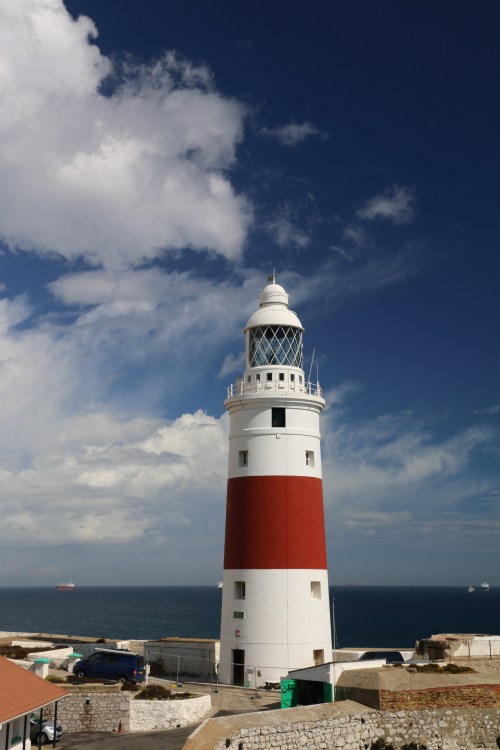
Lighthouse at Point Europa.
We waited in line for most of an hour to buy tickets for the tram up the mountain and then were whisked up 20 0r so per car like so many sardines in a can. There are signs warning people not to bring anything in a plastic bag because the monkeys (tailless macaques sometimes called “Barbary Apes,” but actually monkeys) associate them with food and will steal them. The doors opened at the top, we stepped out and instantly a man carrying a plastic bag was left bagless as a swift thief grabbed it and was gone. It touched the ground a few times and made a clunking sound, so my guess is that he had something inside the bad he probably wanted to keep. Oh, well. There is no chasing these creatures– they are fleet and agile and armed with impressively long canine teeth. When your stuff is gone, it’s GONE. Within a few more seconds a young child in a stroller was sobbing because another monkey had grabbed her pink blanket and disappeared in the rocks. Mommy looked as though she was thinking about the implications of the loss of the favorite blankie.
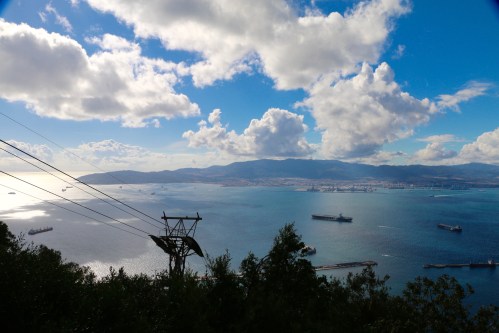
Tramline up/down the mountain.
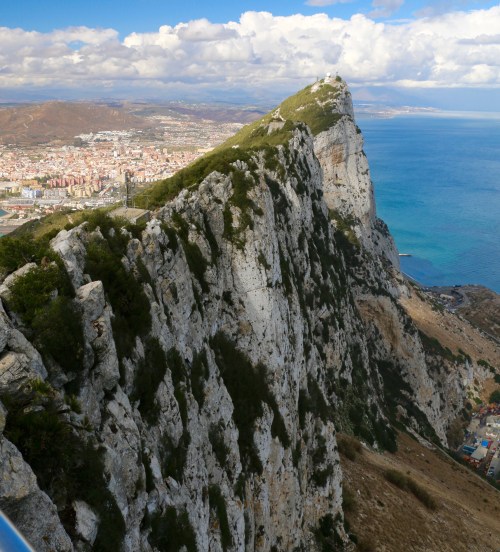
The Rock.
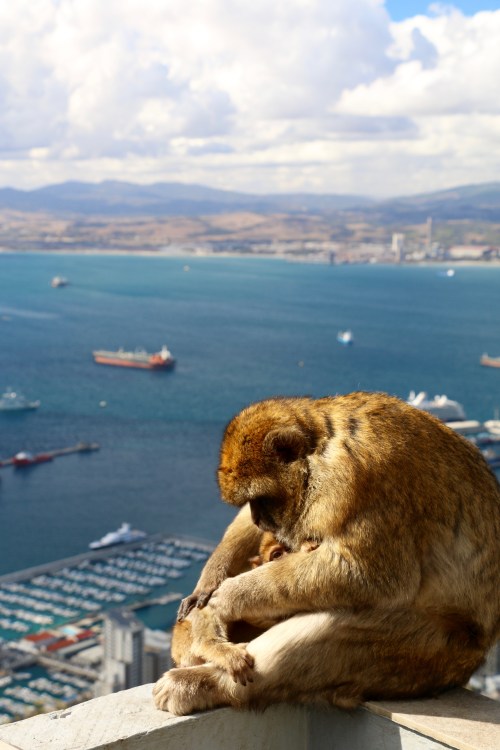
Madonna Macaque and Child.
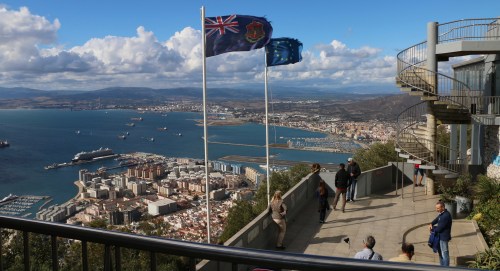
The Upper Landing where the tram stops.
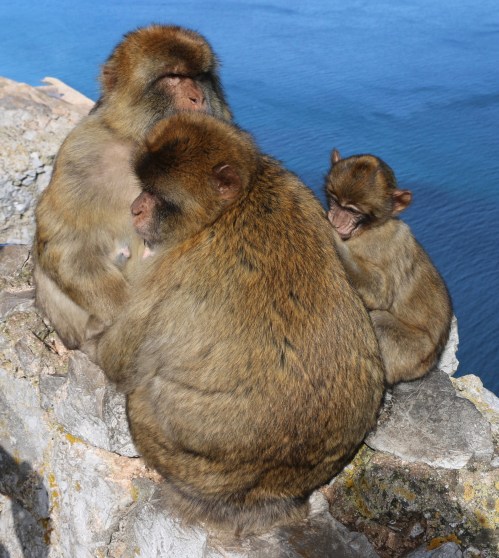
Macaques, chillin’
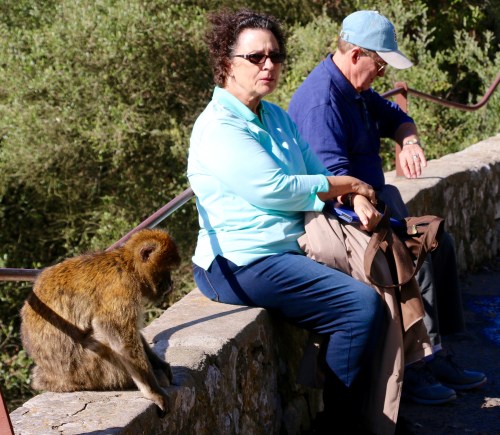
Monkey, April and Richard. See no evil…
We walked around up on the top of a lesser peak and took some pictures, and then it was time to leave. This was where we were confronted by one of the absurdities of the place. Our tickets were one-way. If we wanted to ride the tram back we’d have to buy another one for the way down. We decided to walk. Error. The route down is very poorly-signed so we weren’t really clear on where to go, so we started down the most logical-looking road only to come to a dead end. Then we found the route and it soon degenerated into a rocky, shale-strewn trail. Richard and April decided it looked too dangerous so they determined that they’d go back and find another way to the bottom, hopeful that they’d find a way that avoided walking. I asked if they minded if I continued walking down the trail and they didn’t object, so we separated then and they started back up while I continued down. Within five minutes I was again on a well-paved road, but even if they had come with me and managed to negotiate the slippery trail they would have had a long march ahead. Walking steadily downhill at what I estimate was about a 4 mph pace, it still took me 50 minutes to get back to where we parked the car. Then I waited, and while I waited I started thinking of all that could have gone wrong for R and A. I lay down on a wall out of the constant wind and waited, and then a bus arrived and they both disembarked. They had thrown themselves on the mercy of the tram man and he had let them ride down for free.
We got in the car and found ourselves in a traffic jam of cars and motorcycles on the way out. Between every lane of cars motorcycles and scooters zipped in and out and around and through traffic, complicating the process of exiting.
It was a relief to be out. They couldn’t pay me enough to live there, or even to visit again. As a traveler I’m pretty tolerant of the common frustrations of differences of culture and climate, but this was something different– this was more like an absence of soul, as though there is nothing of any substance to recommend Gibraltar. The next morning at the hostal one of the employees told me that he had considered warning me about it but had decided that we needed to see for ourselves. He was no doubt right, because we would have gone anyway. I offer you, gentle reader, the caveat we would have ignored: don’t go.
It took so long to negotiate our way into and out of Gibraltar that it was dark by the time we returned to El Puerto, so we went straight to the town and found a restaurant and ate dinner before going back to the hostal. The gate to the parking lot was closed when we finally arrived so we had to call the owner and he came out and opened the gate and we fell into our respective rooms and went to sleep.
The next morning was a reverse of the trip from the airport– missteps, mistakes, misdirections– but we finally found our way and checked in the rental car, went through customs and then cooled our heels waiting for the flight to Barcelona, about which I will report in a subsequent post.
 soggiorno13
Drawing a line through “Gibraltar” on my list. Much appreciated. Lead on.
Gibraltar rated a big “meh.”