
The Arno River flows 150 miles from the Apennine Mountains and through the center of Florence before emptying into the Ligurian Sea just west of Pisa, about 45 miles west of Florence. While still in the mountains the geography of the region adds many other smaller streams to the flow of the Arno by the time it reaches Florence and flows under the city’s many bridges, including the most famous of them all, the Ponte Vecchio. At its best the Arno is a brown and muddy-looking stream that gives the impression of something slow and sluggish and even stagnant. While there are fish in the lower reaches of the river, I wouldn’t willingly eat them, tainted as they would be by farm drainage and assorted other pollutants. Perhaps it was once a clean stream, but no longer.
In early November of 1966 there had been a period of steady rain, particularly in the Apennines, and by November 3 the Arno had swollen to a dangerous level. Upstream from Florence there was concern about the possibility of the dams on the river failing because of the growing pressure of the rising water.


On November 4 those concerns became a reality. The dams reached capacity and then exceeded it and the engineers reacted by increasing the flow into the river, opening the flood gates. The Arno rushed toward Florence at nearly 40 miles per hour. When it reached the city the flow was so high that the bridges became like dams, swelling the river to ever-higher levels until it breached the walls meant to keep it in its channel, and freed of that constraint it crashed through the city, turning some streets into churning channels and speeding the flooding of central Florence.
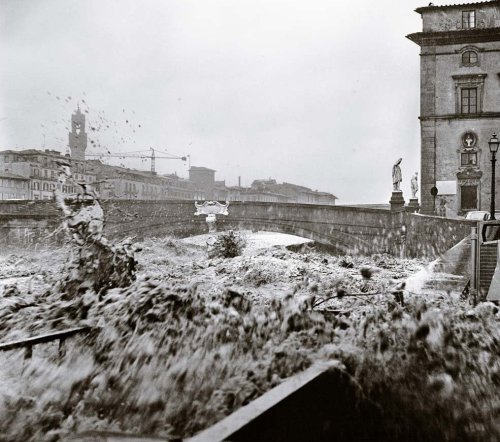
By 9 am the only remaining sources of electricity, hospital emergency generators, failed. Landslides closed roads into and out of Florence and the water seethed through the narrow streets and lanes and alleys, forced by their limited space to grow deeper and higher and faster. By 9:45 the Piazza del Duomo was flooded and water was gushing down the Via Calzaiuoli, the main street between the Piazza della Signoria and the Piazza Duomo, like a torrent.
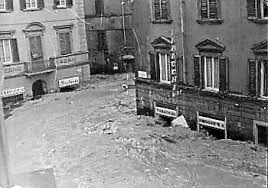
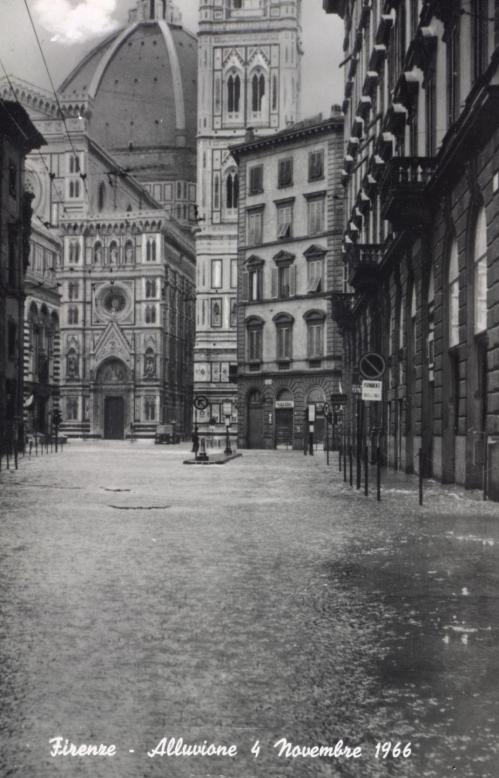
In the Piazza Santa Croce area the water reached a depth of 22 feet, high enough to flood the interior of the basilica, ruining some of the paintings hanging on its historic walls.
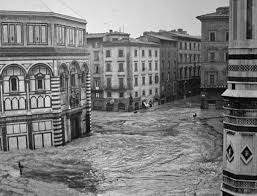
By the time the floodwaters began to recede around 9 pm 101 people had died, a number that probably would have been much higher had not the city been preparing for a holiday, and leading many people to haveleft town for short vacations or celebrations. But their absence also compounded the artistic disaster because so many businesses and museums and libraries were closed and locked, preventing quick actions to save their contents. 5,000 families were left homeless. 6,000 stores were forced out of business. One report says that 60,000 tons of mud, rubble, trash and sewage was left in the streets and in the piazze.
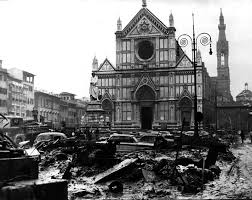
Immediately after the disaster people began to mobilize to clean up. Several groups formed seemingly overnight and more or less spontaneously in response to the emergency. One group was referred to as the “Mud Angels,” a group of people who helped clean the streets and salvage art works and books. Experts from all over the world gave up their time and money and expertise to help clean and restore works of art. Imagine just removing 120 MILLION pounds of mud and debris! How do you move it? Where do you put it? But they did, bucket by bucket, wheelbarrow by wheelbarrow.
Another prominent group were the “Flood Ladies,” a group of female artists who gave artwork to the city.
Many other efforts were joined. The famous Italian film director Franco Zeffirelli made a short movie called “Florence: Days of Destruction,” to raise awareness. The film was released only a month after the flood and was narrated by Richard Burton. Pablo Picasso auctioned off a painting and gave the money to the flood recovery efforts. Cities around the world raised money to support the effort as well.
Around Florence even today you can still see signs indicating the levels of depth the water reached on that fateful day, including on the inside walls of both the Duomo and the Santa Croce.
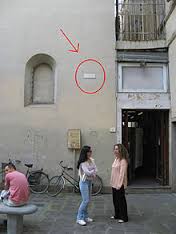
Artwork damaged is still being repaired even now, the 50th anniversary of that flood. The walls keeping the river in its bed have been raised, but that of course is no guarantee that it can’t happen again. Laws have been passed to prevent books and other particularly vulnerable artifacts from being stored at ground level.
The city lives on and moves on, perhaps in a sort of denial of the future possibilities, or maybe it’s just that famous Italian fatalism that we see still see evidence of in the reactions of the people to other natural disasters which could be seen as entirely predictable, such as the earthquakes in the Apennines. Their attitude seems to say, “If God wills it, what can I do?” Not my personal attitude, but who am I to challenge theirs?
 soggiorno13